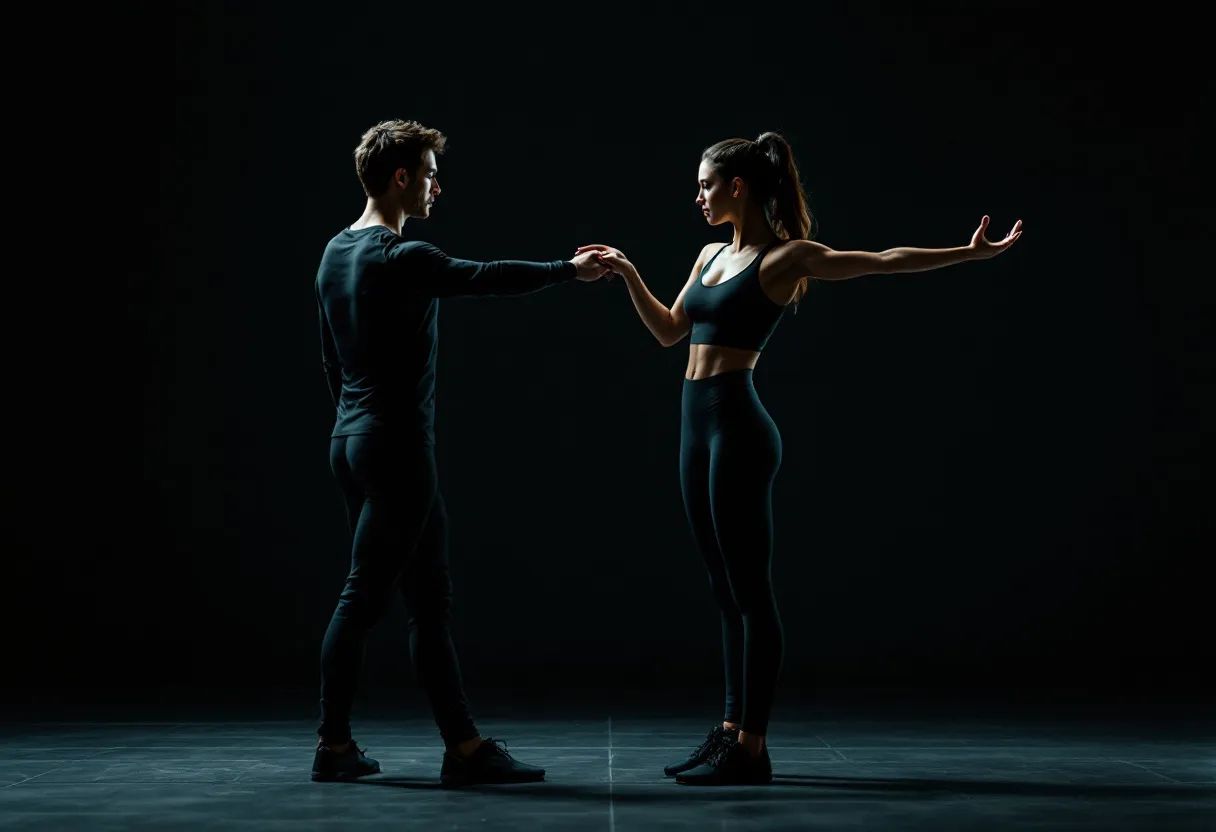
Twenty minutes before your first West Coast Swing social, your dance bag has one shirt in it, a plain cotton tee from the back of the closet. Ninety minutes into the night, that shirt is a wet, heavy weight stuck to your back, and every partner who takes your hand feels it too.
This guide is the reference for what actually goes in that bag: tops and fabric, fit and sizing, footwear, how a weekly class differs from a first social and a competition floor, how many pieces to pack for a weekend of dancing, and how to keep performance fabric working past wash forty. No etiquette, no technique. Just the kit, and why each piece is built the way it is.
What to wear for partner dancing: the short answer
A synthetic stretch top beats cotton every time on a partner-dance floor. Look for a nylon or polyester blend with spandex or elastane worked in, at a weight around 200 to 240 GSM, with flatlock seams and no zippers or buttons near the torso. Fit slim, not baggy and not compression-tight. On your feet, a shoe with a suede or leather sole works better than a rubber-soled sneaker. Pack a spare shirt for anything past three hours, and two spares for a full day of dancing. Wash cold, skip the fabric softener, and hang the shirt to dry. That covers the decision for most partner dancers most of the time. The sections below cover why, and what changes for your specific situation.
Tops: the fabric that actually matters
Cotton is the default because it is the default for every t-shirt in the drawer, not because it works on a dance floor. Cotton absorbs moisture into the fibre itself, so it gets heavier as the night goes on and clings to skin once it is wet. A synthetic fabric, nylon or polyester, behaves the opposite way. It is hydrophobic, so it pushes sweat to the surface to evaporate instead of holding onto it, which keeps the shirt lighter and lets it dry between dances.
Fabric weight is measured in GSM, grams per square metre, and it is the number that separates a light summer layer from something built to hold its shape under load. A fabric-weight guide for apparel brands puts summer-weight cotton at 120 to 160 GSM and winter-weight cotton at 200 to 300 GSM. A synthetic dance top built around 200 to 240 GSM sits inside that heavier band on purpose. It wears like a technical garment, not a t-shirt that happens to stretch.
We have made the long argument for this elsewhere. Why your dance clothes matter more than you think lays out the full case. Our head-to-head of cotton, polyester, and merino scores the three fabrics dancers actually debate, and the timeline of exactly how a cotton shirt fails walks through what happens to a cotton tee hour by hour. The best fabric for dance clothes rounds up the picks if you are shopping right now.
If sweat management is the specific problem you are solving, in a hot climate or across a six-hour social, our sweat-specific shirt buying guide breaks down fabric picks by scenario.

Fit and sizing: getting both right
Fit on a dance floor has two failure modes. Too loose, and the fabric bunches under a partner's hand and catches during a spin. Too tight, and a compression cut restricts the reach and extension partner dance demands, and runs hot because there is no air gap between skin and fabric. The middle ground, a slim but not compression cut with stretch built into the knit, is what most technical dancewear aims for. Try it on before you buy rather than guessing from a size chart.
How a dance top should fit breaks down what that middle ground looks like, garment by garment. Long sleeve, tank, or tee covers how sleeve length changes the fit equation, since a longer sleeve has more fabric to manage through a spin.
For the compression question specifically, our comparison of compression and loose fits scores both against what the floor actually demands, not against a gym mirror.
Sizing runs its own problem, separate from cut. A shirt that measures correctly flat on a table can still fail once your arms are overhead or your torso is turning, because standard size charts are not built around dance-specific movement. Our sizing guide walks through exactly what to check before you order.
Footwear: what belongs on the floor
A rubber-soled sneaker grips a dance floor too well. Rubber is built to stop you, which is exactly wrong for a pivot or a spin. Swivells' breakdown of swing dance shoe soles explains the mechanism plainly: suede and leather soles give a controlled slide, letting a dancer rotate cleanly instead of having the shoe stick and forcing the twist up into the ankle and knee.
A dedicated dance shoe with a suede or split sole solves this without giving up support, and it does not need to be a formal ballroom shoe. Some social dancers wear a sneaker with the sole shaved down instead. Our full rundown on shoes for partner dancing covers both the dedicated options and the sneaker workaround.
What to wear changes with the room
A weekly class calls for whatever you would train in, a breathable top with some stretch and room to move. What to wear to your first dance class covers that baseline.
A social raises the stakes. It runs longer and puts you in closer contact, often in a room with worse air conditioning than the studio you trained in. What to wear to a social dance covers that shift, and for anyone stepping onto a floor for the first time, our dedicated first-social buying guide runs the full checklist.
Competition changes the brief again. What to wear to West Coast Swing, social versus competition covers the differences, including a number pin that needs somewhere reinforced to sit and a cut that needs to read clearly from a judge's row.
Packing for a weekend of dancing
A weekend event usually stacks several socials and at least one banquet or showcase night into forty-eight hours, often with no laundry in reach. Packing by the day instead of by the outfit undercounts almost every time.
Our full packing breakdown for a dance weekend runs the actual math event by event, so you are not guessing how many tops make it through a three-day festival.
The shirts you are packing for are the ones under the most load. What body heat does to a dance shirt over a long night and why a dance shirt starts to smell, and how to stop it both explain the mechanism, heat and bacteria working on the fabric itself, which is exactly what a spare shirt in the bag is solving for.
Caring for performance fabric
Performance fabric is engineered, and washing it like a plain t-shirt shortens its working life fast. Cold water preserves the elastane fibres that give the fabric its stretch, where hot water breaks them down and shrinks the synthetic base. A dry-cleaner's guide to washing workout gear is blunt about the single biggest mistake, fabric softener. It coats the fibre in a waxy film that clogs the moisture-wicking channels the whole garment was built around, and the damage does not reverse.
Skip the tumble dryer too. Heat degrades stretch fibres the same way a hot wash does, which is why a shirt that used to snap back into shape starts hanging loose after a few months in the dryer. Air dry instead, inside out and away from direct sun. Our full care guide runs the complete routine, wash to storage.
This is also the difference between dancewear and the gym clothes already in the drawer. Dancewear vs gym clothes covers why a shirt built for a squat rack and a shirt built for six hours of close-contact partner work are not interchangeable, construction included.
The gear list, by context
At a weekly class, a breathable top with some stretch and shoes you can pivot in cover it. At a first social, add a synthetic stretch top at 200 GSM or above and a spare shirt in the bag. Suede-soled shoes help if you have them. For a full weekend, two to three tops and a dedicated dance shoe are the minimum. Plan the wash routine before you leave, not after you get home. For competition, look for a top with a reinforced zone for the number pin and a cut that reads clean from the judges' table. Pack a second outfit if qualifying and finals run the same day.
Qanvero built the Corda to sit at the top of that list by default. It runs 220 GSM with four-way stretch. Flatlock seams keep it comfortable against skin, and a reinforced zone is built in for a competition pin. It is one shirt. It will not pack the whole bag for you, but it covers the top of that list by default. What makes the best dance shirt runs the fuller buyer's checklist if you want the longer version.
Common questions
What should I wear to my first west coast swing social?
A synthetic stretch top rather than cotton, at a weight of roughly 200 GSM or higher, cut slim rather than baggy. Bring a spare shirt if the social runs past three hours. Our dedicated first-social guide walks through the full checklist.
What fabric is best for sweaty social dancing?
A nylon or polyester blend with spandex or elastane, not cotton. Synthetic fibres push sweat to the surface to evaporate instead of absorbing it, so the shirt stays lighter and dries between dances. Our sweat-specific shirt guide breaks down picks by scenario.
Should I wear compression or loose-fit clothing for partner dancing?
Neither extreme works well. Compression restricts the reach and extension partner dance needs and runs hot with no air gap against skin. Loose fabric bunches under a partner's hand and catches mid-spin. Our full comparison scores both fits against what the floor actually demands.
How do I find the right size dance top?
Try it on with your arms overhead and your torso turned, not just standing flat, since that is closer to how the fabric is loaded on the floor. Our sizing guide covers exactly what standard size charts miss for dance movement.
How many outfits do I need for a dance weekend?
At minimum two to three tops for a multi-day event with limited laundry access. Our packing breakdown runs the count by event, so a three-day festival does not leave you wearing the same wet shirt on day two.
How do I make performance dance fabric last?
Wash it cold. Skip the fabric softener, since it damages the fibres that give performance fabric its stretch and its wicking, and let it air dry instead of using the tumble dryer. Our full care guide runs the complete routine.
Written by a Qanvero westie. We have shown up in the wrong shirt more than once, and one time with zero spare tops for a three-day festival. This guide is the checklist we wish someone had handed us first. By dancers, for dancers.
Five situations are specific enough to deserve their own treatment: what to wear dancing on a night out, the best colours to wear for dancing, how to look good at a dance social all night, how to look good under stage lighting, and dance clothes you can wear as streetwear.