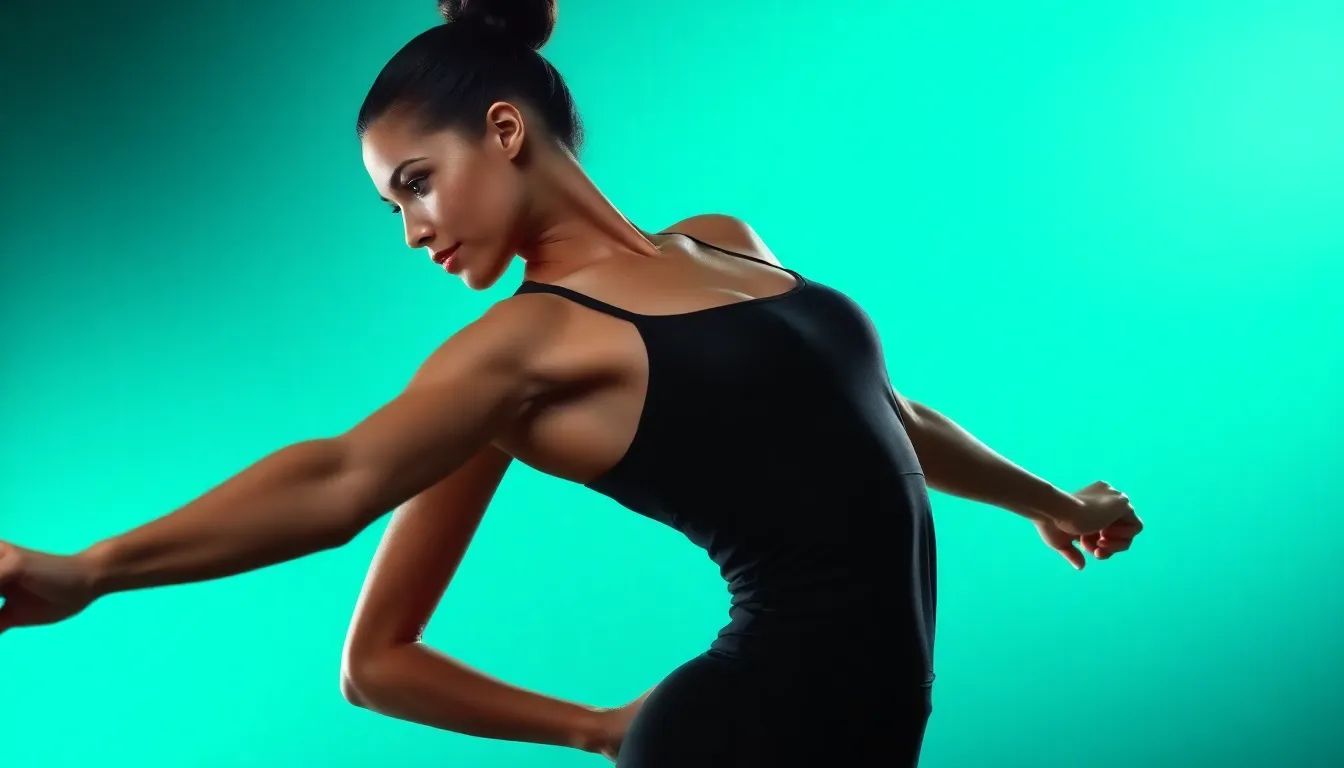
A dance top fails in one of two directions. Too tight, and by hour three the chest feels strapped and every deep breath fights the fabric. Too loose, and the hem flies up on the first fast spin while you tug it down between dances. Most dancers have owned both, and worked out the right fit only by living through the wrong one.
Dance fit is not gym fit and it is not street fit. A top for the floor has to hold close enough to stay put through a spin, and stay free enough to let your arms go fully overhead and your spine rotate, for six hours in the heat. That is a narrow window. Here is how to find it.
Start with the shoulders and arms
Raise both arms straight overhead in front of a mirror. The hem should stay close to where it started, and the shoulders should not pinch or drag. If the whole shirt climbs toward your ears or the armholes cut in, the top is cut for standing still, not for a follower's hand sweeping up into a turn.
Rotation is the second test. Twist through your upper back as if leading a whip or anchoring out of one. The fabric should travel with you and settle back flat. A top that creases into a twist and stays bunched will do the same thing all night in the close hold, where a partner feels every fold against their arm.
The hem is where most tops lose
The most common dancewear complaint is a hem that rides up. It happens when the top is too short, too loose, or too slippery to stay tucked. On a spin the pull of the turn lifts loose fabric, and on an overhead move a short hem simply runs out of length and exposes the midriff you did not mean to show.
A dance top wants a hem long enough to stay covered when your arms go up, and a fabric with enough grip and recovery to fall back into place on its own. You should not be adjusting your shirt between every dance. If you are, the fit is quietly doing your job for you, and doing it badly.

How close is close enough
Slim wins for dancing, but slim is not the same as tight. The target is a top that skims the body and follows your lines without squeezing your ribs or pressing heat against your back. You should be able to take a full deep breath at hour five and feel no resistance from the shirt at all.
This is where stretch and recovery matter more than the number on the label. A knit with good recovery can sit close and still give with every move, then spring back to shape. A stiff fabric at the same measurement feels like a cast by the second song. Fabric and fit are the same conversation, which is part of why your dance clothes matter more than the size tag suggests.
Cropped, fitted, or longline
Cropped tops suit dancers in high-waisted bottoms who want freedom at the midriff, as long as the crop is not so short that it climbs on every overhead reach. Fitted regular-length tops are the safe all-rounder, covered and close without fuss. Longline tops give the most coverage and stay tucked best, which some dancers prefer for the close hold.
There is no single right length, only the right one for your body and your style. What stays constant is the mechanics underneath: reach, rotation, and a hem that holds. Pick the length you like the look of, then judge it against those three, not against how it sits while you stand still in the shop.
What the right fit feels like at hour six
The clearest test is the one you cannot run in a fitting room. A top that fits for dancing disappears. You stop noticing it is on. No tugging the hem down, no peeling it off your back, no bracing your breath against the chest between songs. The shirt does its job quietly while you do yours.
That is the standard the Corda is cut to, a slim breathable knit with the length and recovery to stay put through a spin and the give to let you breathe at hour six. A fit you forget is the entire goal.
Common questions
How should a dance top fit?
Close but not compressing. It should stay put when you raise your arms overhead, move with you on a spin and settle back flat, and let you take a full deep breath late in the night. If you are adjusting it between dances, it is the wrong fit.
Should dance tops be tight or loose?
Slim beats both extremes. Tight restricts breathing and traps heat, while loose rides up on spins and bunches in the close hold. A close skim with good stretch and recovery gives you the security of fitted with the freedom of loose.
Why does my shirt ride up when I dance?
Usually the hem is too short, too loose, or too slippery to stay tucked, so spins and overhead moves drag it up. A longer hem with better grip and recovery fixes it, which is more about cut and fabric than about sizing down.
What length of dance top is best?
Whatever stays covered through an overhead reach and the close hold. Cropped works with high-waisted bottoms, fitted regular length is the safe all-rounder, and longline gives the most coverage. Judge the length by reach and rotation, not by the mirror.
Dance fit lives in a narrow band between tight and loose, and the floor finds the edges of that band faster than any fitting room can. Reach, rotation, hem, breath. Get those right and the rest is taste.
Qanvero cuts tops to that band on purpose, for the spin and the close hold and the sixth hour rather than for the hanger. If you are tired of fighting your shirt mid-dance, the Corda is built to be forgotten.
Written by a Qanvero westie. We have tugged a riding-up hem through an entire social and sworn never again. The brand is by dancers, for dancers.