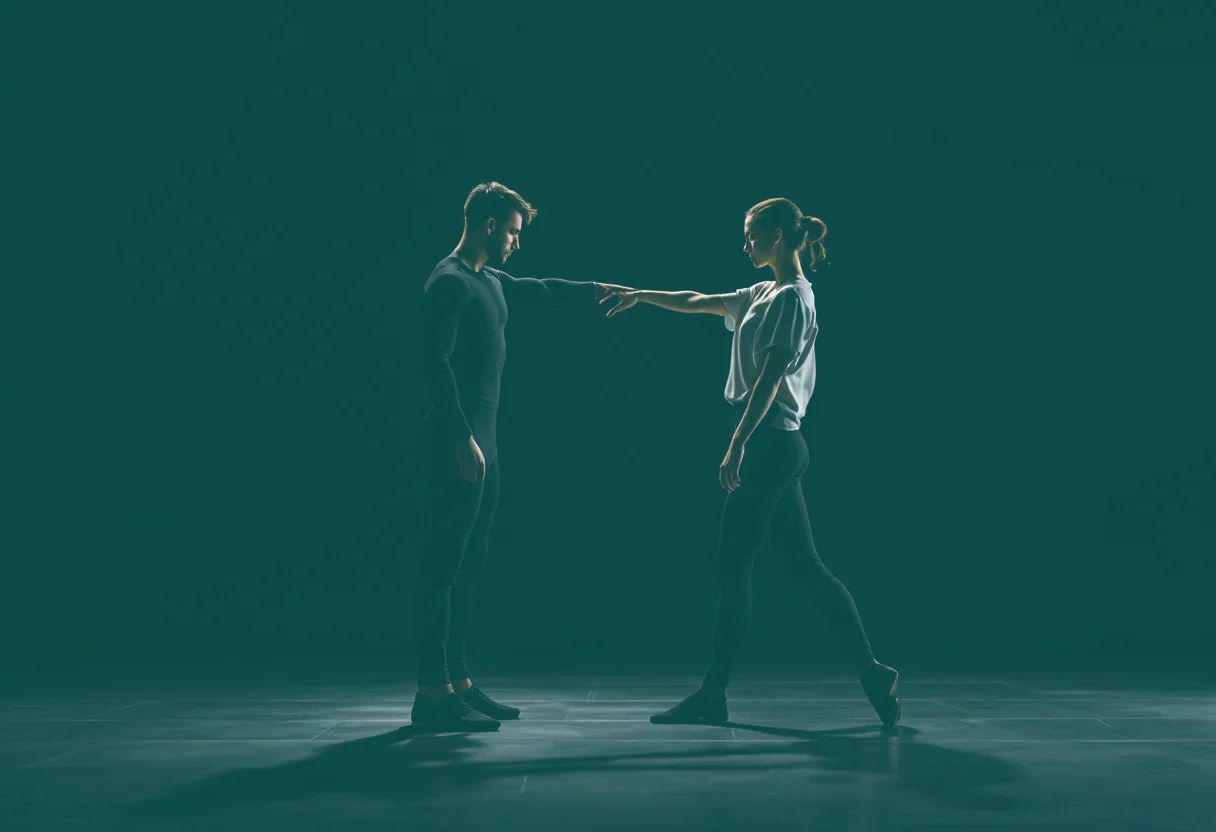
A compression top holds flat against the back through a full turn, with nothing bunching against a partner's hand in close hold. It also leaves a red line across the ribs by the third song, once the elastane content is high enough to earn the name. A loose tank solves that problem and creates a new one: full reach overhead, then a fold of loose fabric catches on a ring or a watch strap mid-spin. Same floor, same night, two different failure points.
That is the real tradeoff behind compression versus loose dancewear, and it gets decided by fabric construction long before either shirt reaches a dance floor.
Compression or loose: the short answer
Neither extreme is built for partner dance. True compression fabric commonly blends nylon or polyester with 10 to 20 percent spandex or elastane, well above the roughly 10 percent baseline standard technical dancewear runs, and is cut specifically to hold tight against muscle rather than move freely. That is the wrong direction for a shape that needs full overhead reach and torso rotation, sustained for hours in the heat. Loose fabric solves the tightness problem and creates its own: with nothing holding it close, it bunches, rides, and catches. The fit that actually works on a floor sits between the two, a slim cut built on four-way stretch fabric that does not qualify as compression at all.
What compression fabric is built to do
Compression garments are not tight by accident. A 2021 systematic review of compression-garment research, published in Sports Medicine, found that compression reduces muscle oscillation and raises localised skin temperature, exactly the two properties a recovery or running garment is engineered around. That same construction works against a dancer. Less give at the shoulder and ribcage cuts into the overhead reach and torso rotation partner dance asks for from both roles, and a fabric engineered to raise skin temperature is the last thing worth wearing six hours into a hot room.
What loose fabric gets wrong
Loose fabric fixes the restriction problem instantly. Nothing holds it snug, so overhead reach and torso rotation cost nothing. The tradeoff shows up in motion instead. Without stretch and recovery holding it close, loose fabric bunches at the exact moment a spin twists it, and a hem with no snap climbs the same way a badly cut top's hem always does mid-turn. We have covered that specific hem mechanic in more depth elsewhere. Loose fit trades one failure for another rather than solving it.
The fit that actually works
The middle ground is not a compromise, it is a different category of fabric. Four-way stretch fabric moves both across the body and along its length, unlike two-way stretch, which only moves in one direction and suits a looser cut. A slim top built on four-way stretch holds close enough to stay flat through a spin without the high-elastane construction that defines true compression. It gives the reach and rotation loose fabric gives away for free, and the flat-against-the-back stability compression gives on purpose, without either one's failure mode. That is the standard the Corda is cut to, a slim four-way stretch knit, not a compression garment, built to disappear at hour six instead of squeeze.
The comparison, scored
On overhead reach and torso rotation: loose wins, a slim four-way stretch top ties close behind, compression loses the most ground. On staying flat through a spin: compression wins, the slim four-way stretch top ties close behind, loose loses the most ground. On heat over a multi-hour social: loose wins, the slim four-way stretch top runs second, true compression runs last, for the skin-temperature reason above. Add it up and the slim four-way stretch fit is the only one that does not lose badly on any of the three.
What changes with layering and heat
Layering changes the calculation. A compression base layer under a looser top can make sense in a cold studio, since the outer layer solves the one job compression does badly alone, holding warmth in without reading as base-layer gear underneath. In a hot, humid social that logic runs backward. A layer added over a high-elastane compression base does nothing to fix the skin-temperature problem the base layer creates, it only gives heat a second layer of fabric to move through. For a hot room, fewer layers built from four-way stretch beats a compression base with something loose thrown over it.
What to actually buy
Skip true compression wear for social dancing, and skip anything sold as loose fit or relaxed fit too. Look for a slim cut described as four-way stretch, not as compression. Getting the size right matters more on a slim cut than on a loose one, since there is less spare fabric to hide a miss, which our sizing guide walks through in detail. For a sweat-heavy social specifically, the fabric's weight and finish matter as much as the cut itself, which our sweat-focused shirt guide breaks down by scenario.
Fit is one piece of a larger kit. Our complete guide to what to wear for partner dancing covers the rest of the kit, from footwear to packing to care.
Common questions
Should dancewear be compression or loose fit?
Neither. Compression restricts the overhead reach and torso rotation partner dance requires and raises skin temperature over a long social. Loose fabric bunches and catches mid-spin. A slim cut built on four-way stretch fabric, not classified as compression, holds up through a full night on the floor.
How much spandex is in compression clothing?
Commonly around 10 to 20 percent spandex or elastane blended with nylon or polyester, well above the roughly 10 percent baseline standard technical dancewear runs, built specifically to hold tight against muscle rather than to move freely.
Does loose clothing work for partner dancing?
Not reliably. Fabric with nothing holding it close to the body bunches under contact and rides up in a spin, the same hem problem any badly cut top runs into. A slim four-way stretch fit solves that without switching to compression.
Is compression fabric good for a sweaty dance floor?
No. Compression raises localised skin temperature by design, the opposite of what a multi-hour social in the heat needs. A breathable four-way stretch fabric that wicks and dries between dances is the better fit for sweat.
What is the difference between four-way stretch and compression fabric?
Four-way stretch fabric moves in every direction and returns to shape, which most technical dancewear is built on. Compression fabric adds a much higher percentage of spandex or elastane on top of that same stretch, built specifically to hold tight rather than move freely. A top can run four-way stretch without qualifying as compression.
Written by a Qanvero westie. We wore a compression base layer to a hot outdoor social once and peeled it off at the first break. By dancers, for dancers.