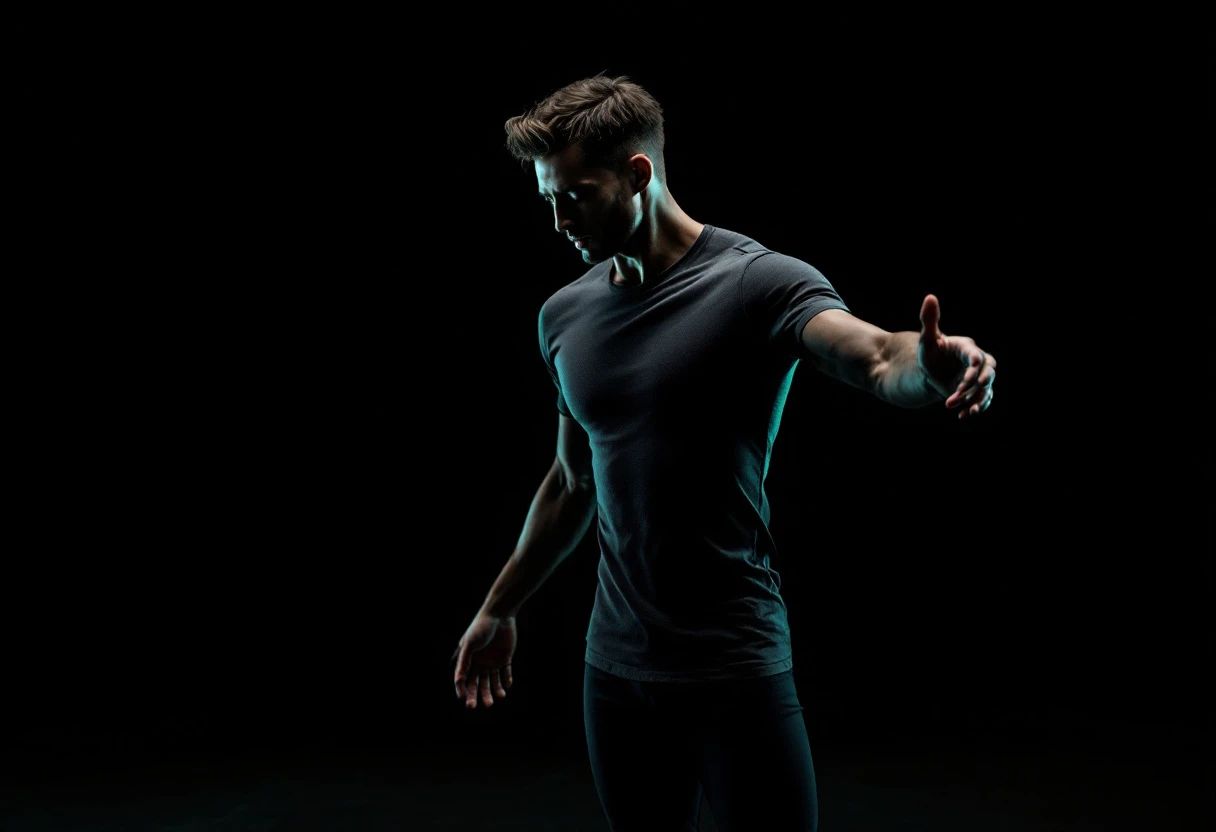
A "moisture-wicking" running tank and a Saturday night of West Coast Swing have almost nothing in common. One is built for a straight sprint. The other spends six hours in close hold, changing partners every three minutes. By hour two, the air conditioning in most Singapore ballrooms has already given up.
This is the buying checklist for a shirt built to hold up under those conditions: the fiber, the weight, the weave, and the handful of numbers worth checking before spending fifty dollars on a shirt that promises cooling technology and delivers a damp cotton blend by the second song.
What "sweat-wicking" actually means
Sweat-wicking is not a marketing category. It is a specific mechanical process called capillary action, and it is measurable. The American Chemical Society tracks a value called moisture regain, how much water a fabric holds against its own dry weight: 8.5 percent for cotton, 4 percent for nylon, and just 0.4 percent for polyester. Cotton absorbs sweat directly into the fiber and holds it there, which is why a cotton shirt gets heavier as a social runs on, and why the person in your arms feels it too by the third song.
Polyester and nylon are hydrophobic enough that sweat cannot soak into the fiber itself, so it has nowhere to go but along the surface and out. That movement only happens if the yarn is built for it. Fibers with a round cross-section pack tightly against each other and leave no space for water to travel. Fabric engineered for wicking uses yarns with a flattened or notched cross-section instead, which opens microscopic channels between the strands. Sweat travels through those channels toward the outer face of the shirt, where it evaporates. Evaporation, not the shirt itself, is what actually cools the skin down.
The fiber blend that works on a dance floor
Pure cotton fails the test above outright. Pure spandex fails a different way. It only wicks moisture moderately on its own, which is why it never ships as a standalone fabric and always gets blended with something else. A shirt labeled "moisture-wicking" on a big-box rack can still be sixty percent cotton with a synthetic thread count too low to do the actual work, so the fiber content tag matters more than the hangtag copy.
What holds up on a partner-dance floor is a nylon or polyester base with roughly 5 to 10 percent elastane or spandex worked in for stretch, adapted for the load a spin and a close hold put on a garment rather than borrowed straight from a running shirt.

Weight and weave: the numbers worth checking
Fabric weight is measured in GSM, grams per square meter, and it is the number that separates a light summer layer from something built to hold its shape under load. One fabric-weight guide for apparel brands puts the lightweight range at 100 to 160 GSM and the performance range from roughly 160 up toward 220 GSM and beyond. A dance shirt sitting at 200 to 240 GSM wears like a technical garment built for six hours of movement. Below that range the fabric feels flimsy under load. Push much past 260 and breathability starts working against the wicking the fabric was chosen for in the first place.
Some technical shirts route mesh panels into the underarm or side seam, the zones that sweat hardest first. A mesh panel lets air move directly through the heaviest sweat zone instead of relying on the surrounding fabric to wick it all away. One textile manufacturer's breakdown of sport mesh construction puts the skin-temperature drop from a well-placed mesh panel at a couple of degrees compared to a solid weave in the same spot, small on paper but noticeable by hour four.
Seams and hardware: what actually wrecks a night in close hold
A shirt can pass every fiber and weight test and still fail on the floor because of what holds it together. Flatlock seams sit flat against the skin instead of raising a ridge, which matters against a partner's hand in close hold for six hours straight. Zippers and metal snaps are worse. They catch on a partner's ring mid-spin, and a shirt that never opens or closes has no reason to carry either one. No zippers. No buttons. No metal hardware near the torso.
Competition changes the brief again. A shirt needs a reinforced zone where a number pin goes, because a stock hem tears the first time a safety pin goes through it under tension.
Fit interacts with all of this too. A compression cut runs hot because there is no air gap between skin and fabric for the wicked moisture to evaporate into. A too-loose cut bunches under a partner's hand mid-spin instead. Our comparison of compression and loose cuts breaks down which fit holds up over a full night, not which one looks best standing still.
How to actually check this before you buy
Marketing copy calls almost everything "moisture-wicking" or "performance fabric." The fiber content tag is the part that does not lie. Look for at least 90 percent synthetic fiber, nylon or polyester, with the remainder elastane or spandex for stretch. If a shirt lists cotton above a trace amount, the wicking claim on the hangtag is decorative.
Weight is harder to check without a spec sheet, but a heavier hand-feel and a fabric that holds its shape when stretched between two fingers are rough proxies for something in the 200 GSM-plus range a lightweight tee will not have. Turn the garment inside out and run a finger along the seams. Flat means flatlock. A raised ridge means a standard seam that will rub raw somewhere around hour three.
What we built into Corda
Corda runs at 220 GSM in a nylon-elastane blend with four-way stretch, at the working end of the weight range above rather than the flimsy end. Flatlock seams run throughout. No zippers. No buttons. Nothing metal within reach of a spin. A reinforced zone at the front, sized for a standard competition pin, means the tag zone does not double as a repair job by the second event of the season.
It is one shirt built to the checklist above from the start. Keeping it working past wash forty is its own discipline. Our performance fabric care guide runs the full routine, wash to storage. And if the shirt is one piece of a bigger kit, our complete guide to what to wear for partner dancing covers fit, footwear, sizing, and packing under one roof.
Common questions
What is the best fabric for a sweat-wicking dance shirt?
A nylon or polyester base with a small percentage of elastane or spandex for stretch, at a weight of roughly 200 to 240 GSM. Cotton absorbs sweat into the fiber and gets heavier through the night. A synthetic blend at that weight moves sweat to the surface instead and lets it evaporate.
Does moisture-wicking fabric actually work for dancing, or is it marketing?
The mechanism is real chemistry, not marketing. Capillary action pulls moisture along non-circular fibers toward the fabric's outer surface, where it evaporates and cools the skin underneath. What varies by brand is whether the fabric is built for six hours of movement or assembled to look good in a product photo.
Is polyester or nylon better for sweat-wicking dancewear?
Nylon holds slightly more moisture than polyester, about 4 percent versus 0.4 percent moisture regain, and often feels a touch softer against skin. Polyester dries faster once it is away from the body. Most technical dancewear blends one of the two with elastane rather than relying on either alone, since the finished fabric's weight and construction end up mattering more than the base fiber by itself.
Should a sweat-wicking shirt fit tight or loose?
Neither extreme. A compression cut runs hot because there is no air gap for wicked moisture to evaporate into, and a loose cut bunches under a partner's hand mid-spin. Our comparison of compression and loose cuts breaks down which fit holds up over a full night on the floor.
How do I wash a sweat-wicking dance shirt without ruining it?
Wash cold and skip the fabric softener, both of which protect the stretch fibers. Air dry instead of using a tumble dryer, since heat breaks those fibers down the same way hot water does. Our full care guide runs the complete routine.
Written by a Qanvero westie. We have bought the shirt that promised cooling technology and delivered a hot, heavy cotton blend by the second song, more than once. This is the checklist we use now before anything goes in the bag. By dancers, for dancers.