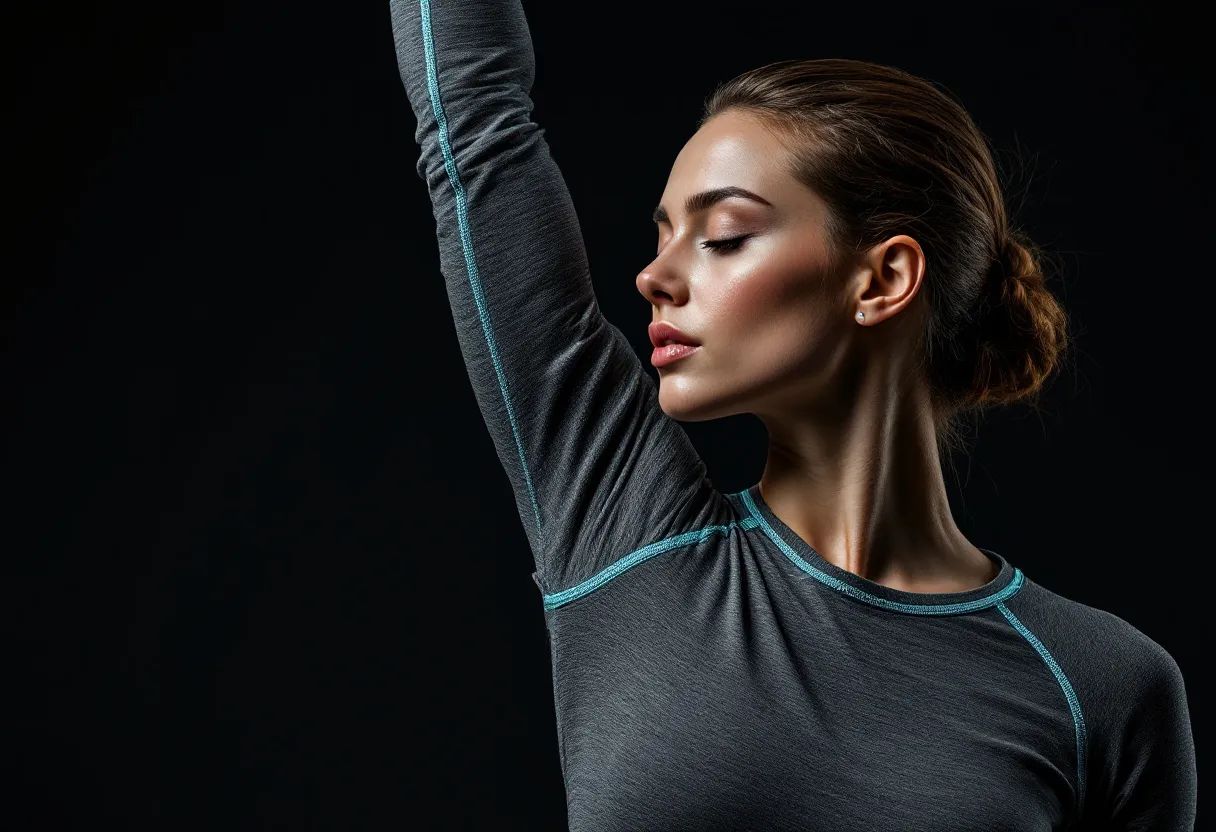
A dance top can fit perfectly in the fitting room and fail by the second song. An arm extends into a frame, and the shoulder seam pulls tight across the joint. A turn later, the hem has crept up past the waistband, and a partner's hand lands on skin instead of fabric. Neither problem shows up standing still, which is exactly how the shirt was measured before it left the shop.
Standard size charts measure a body at rest, chest and shoulder width taken with the arms down. Partner dance never holds a body there. Getting dancewear sizing right means sizing for what a static chart cannot capture: how much reach the shoulder and sleeve allow, how well the fabric recovers once it has stretched, and whether the hem and waistband stay put through a lean or a turn.
Dancewear sizing: the short answer
Size a dance top by what it lets your arms and torso do in motion, not by the number on the tag. A raglan or dropped-shoulder seam clears the joint instead of crossing it, so a lifted or extended arm does not pull the fabric tight. A stretch fabric with real recovery snaps back to shape within seconds instead of loosening after a few socials. Check the hem drop and the waistband construction too, since those are what keep a top in place through a lean rather than riding up mid-song. Try any top on with your arms raised and your torso turned before deciding it fits. The sections below cover why each check matters.
Why a size chart measures a body that never moves
Most size charts are built from static measurement, a body standing still with the arms down. Pattern-makers call the movement-ready version of a garment negative ease. The pattern is cut smaller than the body, and the fabric's own stretch closes the gap once it is on.
That gap has a real ratio behind it. A pattern-making house with two decades in activewear construction states that ten percent negative ease needs a minimum of fifteen to twenty percent fabric stretch to still feel comfortable rather than restrictive, and the margin widens further as the ease increases.
A top sized purely off a flat chest or shoulder measurement has no way to account for that margin. That is exactly why a shirt can measure correctly on a table and still fight you on the floor.
Reach: the shoulder and sleeve problem
A frame in partner dance holds an arm extended, sometimes overhead, for the length of a song. That position loads the shoulder seam and armhole harder than almost anything else a top does. A traditional set-in sleeve, seamed at the point of the shoulder, sits directly across the joint doing that work, and pulls tight the instant the arm lifts.
Pattern-makers account for this by deepening the armhole for overhead movement and reshaping the sleeve seam to run from the underarm to the neckline instead of the shoulder point, a raglan construction, since it clears the joint rather than crossing it.
Test this before you buy, not after. Raise both arms into an extended frame position in the fitting room. If the fabric pulls tight at the shoulder or drags the hem up under the arm, the cut is wrong, whatever the tag says.
Stretch: what recovery actually means
Stretch only helps if the fabric comes back. A fabric that stretches well but never fully returns loosens exactly where partner dance loads it hardest, at the shoulder and across the upper back, until a top that fit at the first social goes baggy by the fifth.
The industry test for this takes thirty seconds. Stretch a swatch, then watch where it lands once you let go. A fabric with strong recovery returns to within five percent of its original size in that half-minute.
Four-way stretch, meaning the fabric gives both across the body and along its length, is what lets a top handle a reach and a turn without one direction fighting the other. A dropped shoulder cut from a fabric that only stretches one way will still bind somewhere. The cut and the fabric have to solve the same problem together.
Ride-up: the hem and waistband problem
A hem cut level front to back looks fine at the mirror and climbs the moment you lean into a dip or extend through a turn. A longer back hem than front, a drop-back hem, is built specifically for that bent-forward position, staying down exactly where a level hem rides up, a detail workout-top reviewers single out by name for the same reason.
Waistband construction carries the rest of the job. A narrow, low-profile elastic gives up support the moment you lean back or twist. A wider band, in the five to eight centimetre range, distributes pressure evenly enough to stay in place instead of rolling.
How to actually size a dance top before you buy
Skip the flat measurement and test the garment the way you will wear it. Raise both arms overhead in the fitting room. Turn your torso as far as it will go. Then lean back slightly, the way you would through an extension. If the fabric pulls at the shoulder or the hem climbs, move up a size or move to a different cut before the first social, not after.
This is a separate question from compression, and worth keeping separate. Our comparison of compression and loose fits covers how much tension a garment should carry at rest. Sizing is about how much room the cut and the fabric leave for the reach itself.
If this is your first time buying for a social rather than a weekly class, our first-social buying guide covers the rest of the checklist, footwear included. Both sit inside the wider picture in our complete guide to what to wear for partner dancing, which covers fabric and footwear alongside fit.
Qanvero's own Corda runs 220 GSM with four-way stretch, sized to the same logic: a slim cut that still leaves the room a frame needs, rather than a straight pull from a generic block.
Common questions
How do I know if a dance top is the right size?
Test it in motion. A mirror check alone will not catch it. Raise both arms overhead. Turn your torso as far as it goes. Lean back slightly, the way you would through an extension. If the fabric pulls at the shoulder or the hem creeps up the waist, the size or the cut is wrong, regardless of what the flat chest measurement says.
Why does my dance top ride up when I dance?
Usually because the front and back hem are cut the same length, so leaning or bending pulls the shorter effective coverage up past the waistband. A longer back hem, built for that bent position, fixes this. A narrow or low waistband makes the problem worse.
Should I size up for a stretch dance top?
Not automatically. Sizing up compensates for a fabric with weak recovery, but the better fix is a fabric that actually returns to shape, tested by stretching and releasing a swatch. A fabric with strong recovery holds a true size through a full social instead of loosening into a bigger one.
What is negative ease, and why does it matter for dancewear?
Negative ease is when a garment pattern is cut smaller than the body, relying on the fabric's stretch to close the gap. It is standard in performance apparel, but the fabric has to stretch further than the ease built into the pattern, roughly fifteen to twenty percent more for every ten percent of ease, or the fit turns restrictive under real movement.
Why does my sleeve feel tight when I raise my arm?
A traditional set-in sleeve, seamed directly at the shoulder point, sits across the joint and resists exactly the motion partner dance asks for. A raglan or dropped-shoulder seam, which runs from the underarm to the neckline instead, clears the joint and gives the arm room to lift or extend without pulling.
Can I trust a brand's size chart for a dance top?
Only partly. A size chart gives you a flat measurement, not how the garment behaves once your arm lifts or your torso turns. Use the chart to pick a starting size, then test the fit in motion before deciding it is right.
Written by a Qanvero westie. We have bought the top that measured perfectly on a hanger and fought us on the floor by the second song. This guide is the sizing logic we wish had come with the tag. By dancers, for dancers.