Third song after the break, arm up for a spin, and there it is. The shirt peels off your back mid-turn and slaps back down a half-second later, cold and already sticking again. Your partner's hand lands on the wet patch at your spine. Neither of you says anything.
"Anti-cling" shows up on hangtags the same way "breathable" does, as a mood rather than a measurable claim. It isn't a mood. Cling is fiber, fabric weight, and knit construction acting together, and each one behaves in a specific, checkable way once it gets wet.
Cling happens when sweat bridges the gap between skin and fabric and surface tension pulls the two together. Fibers that absorb water into themselves, like cotton, add weight and collapse against skin as they saturate. Fibers that push water to the surface instead, like nylon and polyester, stay lighter and looser for longer. Heavier, structured knits hold their shape wet, while thin, flat ones give in faster. Read the fiber and the gsm on the tag, then check whether the knit is open or tight. That combination is what anti-cling actually means, not the word printed on the label.
What cling actually is
Cling is a specific mechanical event that happens at the point where fabric meets skin. A 2018 study in Royal Society Open Science measured it directly. Once skin picks up enough moisture, it softens, and the contact area between fabric and skin increases. Sweat then forms small liquid bridges across that contact area, and surface tension pulls the fabric down against the skin instead of letting it hang the way it does dry.
The same study found this effect varies enormously by fabric. Thin, absorbent fabrics produced the strongest sticking sensation, and it got worse the longer they stayed wet. Fabric built to move water away from skin barely registered as sticky at all, even fully saturated. The fiber makes the difference, not chance.
What fabric doesn't cling when you sweat
Hydrophobic fiber. Polyester and nylon don't absorb water into the fiber itself, so there's structurally less moisture available to form that skin-fabric bridge in the first place. The gap is measurable. Textile science calls it moisture regain, the weight of water a fiber holds relative to its own dry weight. Cotton runs about 8.5 percent, wool closer to 16, polyester near 0.4, and nylon around 4, and it's why cotton fails on the dance floor after about four hours while a nylon or polyester shirt plateaus early and starts drying while you're still dancing.
Moisture-wicking and anti-cling come from the same fiber decision. A fiber that doesn't absorb water into itself has nothing to hold onto your skin with either. For a full side-by-side of how the fibers actually perform across a set, cotton vs polyester vs merino breaks down dry time and odor in more depth, and the best fabric for dance clothes is the wider overview if fiber is the only piece you're solving for.
Fabric weight decides when cling shows up, not whether it does
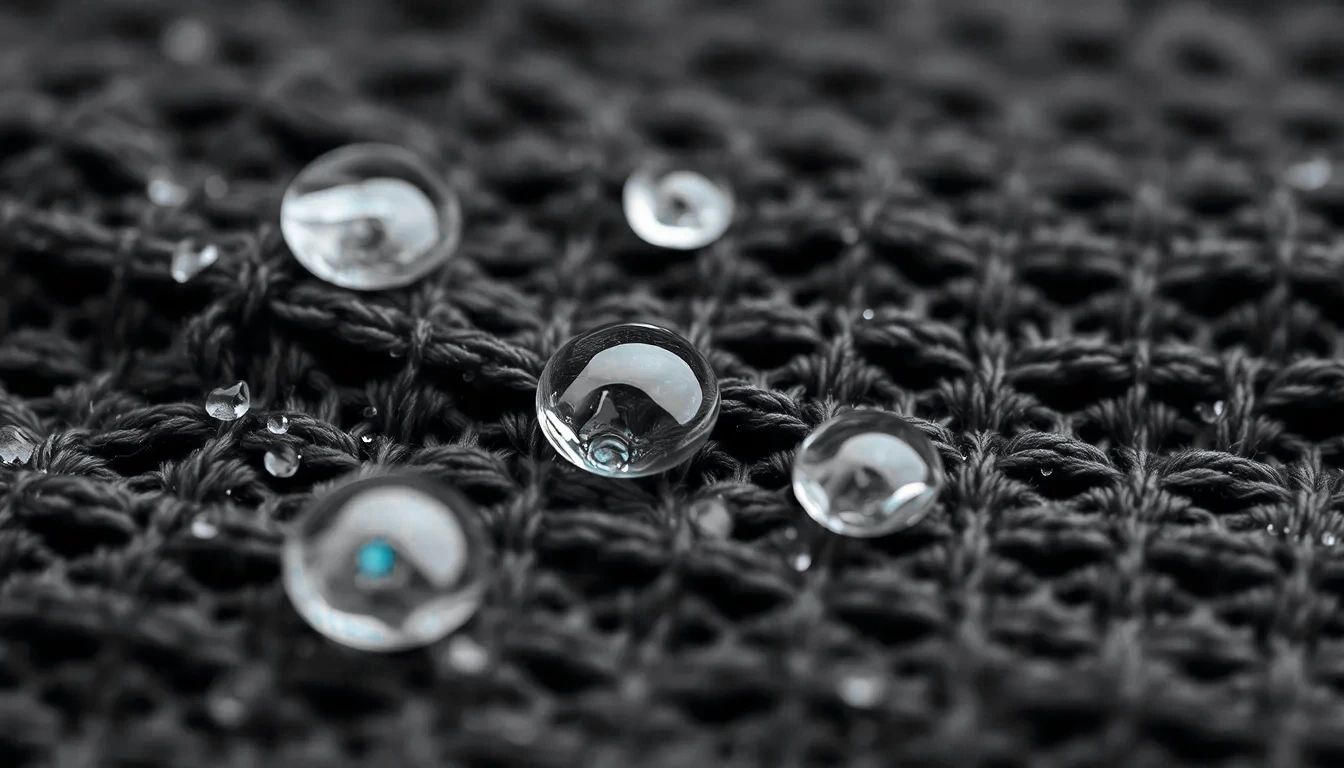
Grams per square meter, or gsm, measures how much material sits in a given area of fabric. Lighter fabrics collapse against skin sooner, since there's less structure to begin with and a small amount of sweat is enough to force them flat. Heavier knits hold their shape longer before that happens, though heavier fabric also absorbs more water in absolute terms and takes longer to dry once it's fully saturated.
That's part of why activewear built for a genuinely long, sweaty session tends to sit in the 180 to 220gsm range rather than the 120 to 150gsm of a basic tee. The Corda shirt runs 220gsm specifically so it holds its shape through a full set instead of going thin and clingy by the second song. 220 grams, four directions covers how that weight pairs with four-way stretch in more depth.
Knit construction decides how fast that moisture actually leaves
Fiber decides how much moisture gets absorbed. Weight decides how long that takes to matter. Knit decides how fast moisture clears the skin side of the fabric once it's there. A tight, flat knit, the kind on a basic cotton tee, gives sweat almost nowhere to go except straight through to the layer touching you. An open or four-way stretch knit has more structure between yarns, giving moisture a path to travel along the fabric's surface instead of pooling against skin. High-performance mesh and stretch knits are built specifically to move sweat toward the outer face of the fabric, where it can evaporate rather than letting it sit at the skin.
This is a construction decision more than a fiber one, which is why two polyester shirts can behave completely differently against your back.
Why this matters more with a partner's hand on it than at the gym
A gym tech shirt only has to survive contact with air. A dance shirt spends hours in contact with someone else's hand and forearm, through close hold and every change of frame. A partner feels cling as information, whether either of you says anything about it or not.
This is also where fiber and knit matter more than a spec sheet suggests. A shirt that clings at the gym is a minor annoyance you shrug off alone. The same shirt clinging on a dance floor is a wet patch someone else's hand lands on mid-turn, which is the exact moment this article opened with.
| Fabric / construction | Cling when saturated | Why | Best for |
|---|---|---|---|
| Cotton jersey, tight knit | High, collapses fast | High moisture regain (about 8.5%) with nowhere for sweat to go | Warm-ups, not the floor |
| Polyester tech tee, tight knit | Moderate | Low regain (0.4%) but a flat knit still holds moisture at skin | Short classes, casual wear |
| Four-way stretch synthetic, about 220gsm | Low | Low regain fiber plus an open knit that routes moisture away | Full socials, multi-hour sets |
| Merino wool blend | Moderate | Higher moisture regain (about 16%) than cotton or synthetics | Cooler rooms, shorter sessions |
| Cotton-poly blend, 50/50 | Moderate to high | Blends inherit cotton's regain, scaling with the cotton share | Casual wear, not sustained sweat |
What to actually check before you buy
Skip the word "anti-cling" printed on a tag. Check the fiber content first. Nylon or polyester wins over cotton for anything past forty minutes. Check the gsm next, aiming for the 180 to 220 range rather than a lightweight tee's 120 to 150. Then check how the knit is described. An open or four-way stretch construction clears moisture faster than a flat, tight jersey, and that's what actually decides how quickly sweat leaves your skin instead of sitting on it.
Fabric is only half the decision. How dance apparel should fit covers what the construction around that fabric needs to do once cling is solved, and the best sweat-wicking shirts for social dancing roundup is the shortest path if you're ready to shop with this checklist in hand.
A shirt that clings at hour three didn't fail because of bad luck. It failed because of a decision made months earlier, in a fiber choice or a knit choice most buyers never get asked about, long before the tag reached a store shelf.
Qanvero builds the Corda around that decision instead of talking around it, at 220gsm with four-way stretch specifically so the fabric holds its structure through a full set. The physics doesn't change by brand. What changes is whether that combination got chosen for a six-hour floor or a gym mirror, and that's the actual question worth asking before anything gets bought on the strength of the word "anti-cling" alone.
Common questions
Is anti-cling the same thing as moisture-wicking?
They come from the same fiber decision. Wicking describes how a fabric moves moisture toward its outer surface. Anti-cling describes what happens at the skin side once that moisture is being moved instead of absorbed. A fiber that wicks well is, in practice, a fiber that clings less.
Does spandex or elastane change how much a shirt clings?
Not directly. Spandex is added for stretch and recovery, not moisture behavior, and it typically makes up a small share of the blend. The base fiber, usually nylon or polyester in a stretch dance shirt, is what actually does the moisture work.
Can a heavier shirt still feel lighter than a thin one once it's wet?
Yes, if the fiber is hydrophobic. Weight affects how much structure a fabric has to work with, not how much water it absorbs. A 220gsm synthetic knit can end up carrying less water weight than a 180gsm cotton one, even though it started out heavier dry.
Is cotton ever fine for dancing?
For a short class or a low-intensity practice session, yes. The four-hour failure point most dancers hit is a function of sustained saturation, not a single spin. Once a session runs past about forty minutes to an hour of real output, cotton's moisture regain starts working against you.
How can I tell a shirt is anti-cling before I buy it, without a wash test?
A hangtag can tell you two things worth trusting: the fiber content and the gsm number. Add a quick look at the knit next. Stretch or mesh reads better than a flat jersey, and that combination is what matters before you've ever sweat in the shirt.
Does fabric color affect how visible cling and sweat are?
That's a related but separate variable. A darker color hides a wet patch better than a light one, but it changes visibility, not the physics underneath it. A dark, cotton-heavy shirt still clings and still gains weight, it just shows it later.