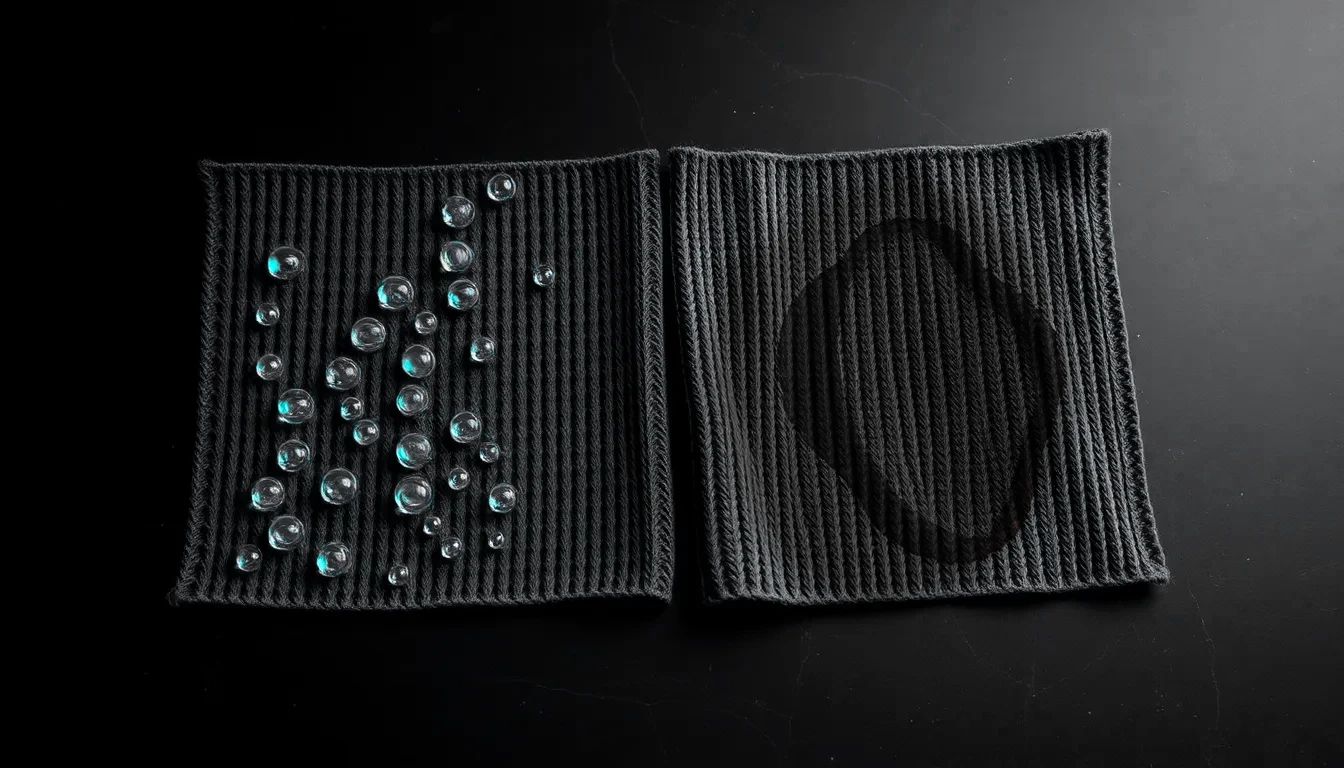
Two shirts hang on the same rack. Both hangtags say moisture-wicking in the same size-fourteen font. One will still feel damp against your spine at hour three of a social. The other will have already dried once and started drying again. The hangtag cannot tell you which is which, because moisture-wicking was never one specific claim to begin with.
There's a number that actually predicts the difference, and it isn't printed on either tag. It's called moisture regain, and it works nothing like a hangtag adjective. Textile science has published it for nearly every fiber in common use, and the way it's measured has been standardized for decades.
Moisture-wicking is a marketing word. More than a dozen accredited tests could sit behind it, or none at all. A hangtag rarely says which. Moisture regain is different. It's a published, standardized percentage for how much water a fiber holds relative to its own dry weight. Cotton runs about 8.5 percent. Wool sits near 16. Nylon holds about 4. Polyester barely reaches 0.4. That gap is most of why two shirts marked the same way can feel completely different by hour three.
What does moisture-wicking actually mean?
Moisture-wicking describes a behavior, not a single test result. A fabric that pulls sweat away from skin and spreads it toward the outer surface, where it can evaporate, qualifies as wicking in the loosest sense of the word. No single industry test decides how much wicking, measured which way, earns the claim.
One accredited textile lab alone lists more than a dozen different tests that could sit behind that one word. AATCC 195 scores how fast a fabric absorbs, spreads, and dries. AATCC 197 and 198 measure vertical and horizontal wicking distance instead, on a completely different scale. None of them is mandatory before a brand prints the word on a hangtag, and almost none disclose which test, if any, actually backs the claim.
That gap matters because two shirts can carry the identical word while performing nothing alike. One fabric might pass a real moisture-management test with a strong score. The other might earn the word from a marketing brief with no lab result behind it at all. The tag looks the same either way.
The number underneath the word
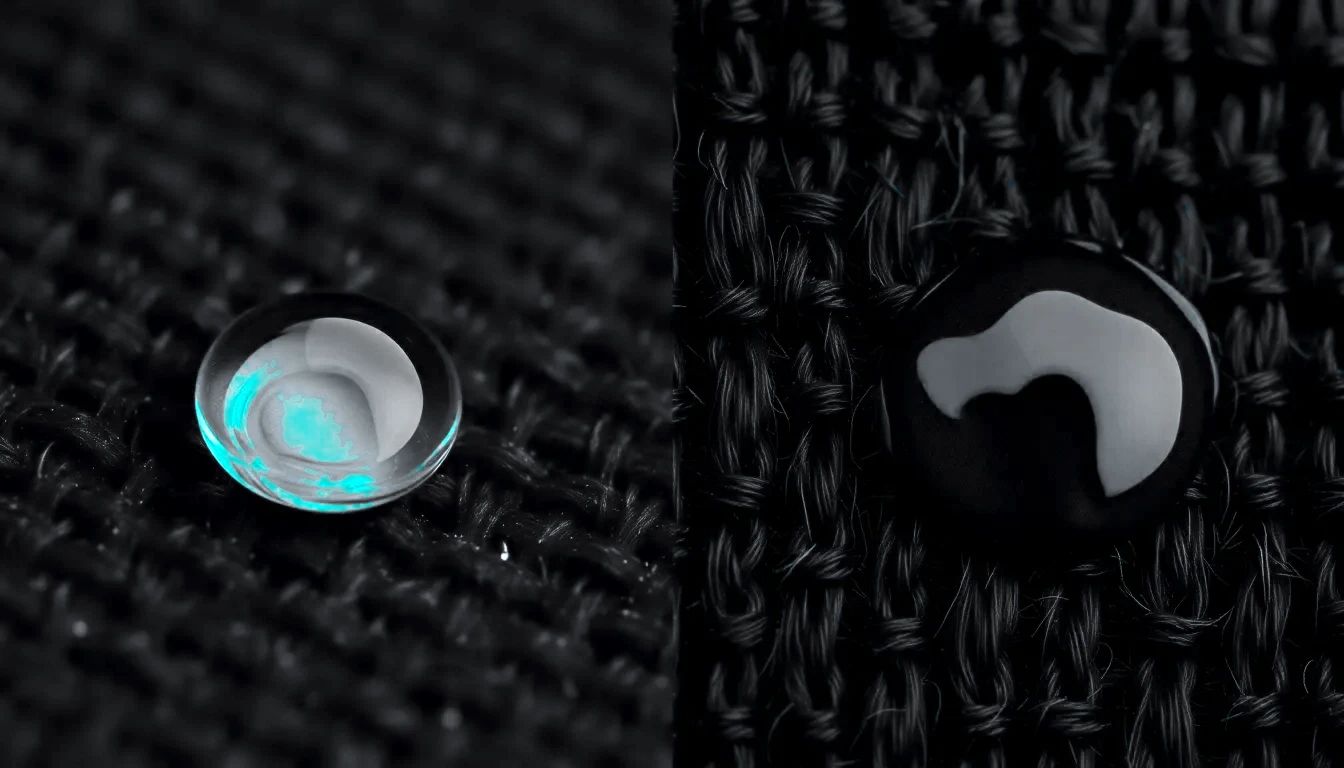
Moisture regain solves a narrower, more useful problem. It measures how much water a fiber absorbs into itself, expressed as a percentage of the fiber's own oven-dry weight. Mills test it by drying a fiber sample to zero moisture, then reconditioning it under standard temperature and humidity to see how much weight it regains. A fiber sitting at 8 percent regain has taken on 8 grams of water for every 100 grams of that bone-dry starting weight. That's a property of the fiber itself, not of a finished fabric's weave or finish, which is why it doesn't shift between brands the way a wicking claim can.
It's also not a new idea. ASTM D1909 has published standard commercial moisture regain tables for textile fibers for decades, precisely so mills and buyers could compare fibers on the same basis instead of trusting whatever a label happened to say. The number was built to travel between brands. A wicking claim was not.
The published figures split fibers into two clear camps. Cotton and wool absorb water directly into the fiber, so their regain runs high. Polyester and nylon absorb almost nothing into the fiber itself, so their regain runs low. The standard commercial tables mills use to grade raw fiber put a specific number on that difference, fiber by fiber.
| Fiber | Moisture regain | What it means wet | Best for |
|---|---|---|---|
| Cotton | About 8.5% | Absorbs sweat into the fiber, gains real weight, dries slowly | Short, low-sweat wear |
| Wool / merino | About 16% | Highest regain here, holds the most water, insulates even damp | Cooler rooms, shorter sessions |
| Nylon | About 4% | Some intrinsic absorption, still drains faster than cotton | Stretch blends needing durability |
| Polyester | About 0.4% | Barely absorbs into the fiber, sweat sits on the surface and evaporates | Full socials, multi-hour sets |
| Spandex / elastane | About 1% | Low regain, but only ever a small share of a blend | Stretch recovery, not the moisture story |
Why the fiber number predicts what a hangtag can't
A high-regain fiber does two things once real sweat starts. It gets heavier, because it's physically holding water inside its own structure. And it stays wet longer, because that water has to evaporate out of the fiber rather than off a surface. Cotton's four-hour failure point on a dance floor comes straight from this number. Low-regain fibers skip both problems, which is most of what shows up as anti-cling in practice.
The effect compounds across a long session. What six hours does to a garment walks through the load a shirt actually carries across a full social, hour by hour. For the fuller side-by-side on dry time and odor, cotton vs polyester vs merino breaks down what this regain gap actually costs a dancer in practice.
None of this is abstract for a partner dancer. A high-regain shirt gets heavier and stays wetter right where a partner's hand lands in close hold, every time the frame changes. The fiber decision made months before the shirt was ever sewn is what actually shows up on the floor.
What to actually check instead of the word
Skip the hangtag's adjective and read the fiber content line instead. Fiber content disclosure is a legal requirement in most markets, not a marketing choice, so it's the one line on the tag that actually has to be accurate. Polyester and nylon sit in the low-regain, dries-fast family. Spandex or elastane shows up in small amounts for stretch, not for moisture control. Cotton and wool sit at the high-regain end, better suited to a short class than a full night out.
A shirt built around a low-regain fiber, the Corda among them, starts from that published number instead of a hangtag adjective. The physics doesn't change by brand. What changes is whether a fiber was chosen for a six-hour floor or a forty-minute gym set, and that choice is checkable before a single drop of sweat lands on the fabric. Reading the fiber content line takes less time than reading the hangtag's marketing copy.
Fiber is one piece of a bigger decision. The best fabric for dance clothes covers weight and knit construction alongside regain, for the full picture beyond this one number.
Common questions
Is moisture regain the same as moisture-wicking?
They describe different things. Moisture regain is a fixed, published property of a fiber, the amount of water it absorbs into itself relative to its own dry weight. Wicking describes how a finished fabric moves moisture across its surface, which depends on knit and finish as much as fiber. A low-regain fiber is what makes strong wicking possible, but the two words aren't measuring the same thing.
Why do polyester and nylon have such different regain numbers if they're both synthetic?
Nylon absorbs slightly more water into its molecular structure than polyester does, even though both are far more water-resistant than cotton or wool. The gap is small in absolute terms, roughly 4 percent against about 0.4 percent, but it's consistent enough that nylon-heavy blends tend to feel marginally more absorbent than pure polyester ones. Neither number moves much with washing or age, since regain is a property of the raw fiber, not a specific garment's history.
Does adding spandex or elastane change a blend's regain number?
Spandex itself sits at a low regain, typically making up a small share of any stretch blend. The base fiber, usually polyester or nylon in a stretch performance shirt, still does almost all of the moisture work.
If regain is published and standardized, why do two polyester shirts still feel different once they're wet?
Regain only describes the fiber. Knit structure and fabric weight both sit on top of that choice, and either one can make one polyester shirt cling while another stays loose. The fiber number sets the ceiling on how dry a fabric can get. Construction decides whether it actually gets there. That's also why a heavier gsm and a tighter knit sometimes work against each other instead of together.
Where can I actually find a fiber's moisture regain number?
It rarely appears on a hangtag. The standard commercial tables are published for the textile industry, not for shoppers, so the fastest real-world substitute is checking the fiber content line and matching it against the low-regain or high-regain family it belongs to.
Does a fiber blend's regain number just average between the two fibers?
Roughly, but not evenly. A cotton-poly blend under about fifty percent polyester still behaves close to pure cotton, since cotton's absorbent fiber dominates the fabric's actual water uptake. Regain doesn't average in a simple straight line. It depends on how much of the blend is actually doing the absorbing.